Key takeaways
- Compare five push up bars for home training, from rotating handles to fixed stands, with notes on grip comfort, base stability, height, and capacity.
- Top Pick: Perfect Fitness Perfect Pushup Elite
- Runner-up: Perfect Fitness Perfect Pushup Rotating
- Also consider: Kipika Push Up Bars
Push up bars are a small pair of raised handles that lift your hands off the floor during push-ups. That raised, neutral grip changes the exercise in a few practical ways: the wrist stays closer to a straight handshake position instead of bending back against the floor, the chest can travel a little deeper between the handles, and the hands rest on a shaped grip rather than a flat surface. For home trainers working in a corner of a room, they are one of the smallest and simplest pieces of strength equipment to own.
The category splits into two families. Rotating handles turn on bearings as you press, so the hand angle can shift through the rep. Fixed stands lock the grip in one position and trade that movement for simplicity and a planted feel. This guide compares five current options across both families, looking at grip shape, base footprint, handle height, and the weight capacity each maker states.
As an Amazon Associate, we earn from qualifying purchases.
Quick Answer
For most home trainers, the Perfect Pushup Elite is the well-rounded pick: rotating handles on steel ball bearings, an 8-inch non-slip base, and a stated 400-pound capacity. If you prefer a fixed grip, the Kipika stands pair a wide anti-slip pad with angled soft-plastic handles, while the Redipo and READAEER pairs suit lighter, portable setups.
1. Perfect Fitness Perfect Pushup Elite

The Perfect Pushup Elite is the best-known rotating design in this category. Each handle sits on a round base and turns on steel ball bearings as you lower and press, so the hands can rotate slightly through the rep instead of staying pinned at one angle. The grips are contoured and made to spread pressure across the palm, and the wide base carries textured treads on the underside to resist sliding on smooth floors.
This is the pair to look at if standard floor push-ups bother your wrists and you want the handle position to move with your arms. The stated capacity of 400 pounds also makes it one of the sturdier rotating options for heavier users or anyone training with a loaded vest. The trade-offs are size and simplicity: the round bases take up more storage room than flat stands, and the rotation has a short learning curve for complete beginners. The listing notes a workout chart is included, and the handles are sold as a pair.
Specs
- Handle type: Rotating, on steel ball bearings
- Base: Round, about 8 inches across, textured non-slip bottom treads
- Stated weight capacity: Up to 400 pounds
- Materials: ABS and alloy steel per the listing
- Model: Perfect Pushup V2 (part number 96506310019)
- Sold as: One pair
2. Perfect Fitness Perfect Pushup Rotating

The original Perfect Pushup Rotating handles are the earlier, simpler version of the same idea. The pair rotates as you press, letting the arms follow a more natural arc, but the design is more compact than the Elite and leaves out some of its refinements. For buyers who like the rotating concept and want the established version of it, this is the straightforward choice.
Compared with the Elite, expect a smaller footprint and a plainer grip. The listing describes the pair as rotating handles designed to reduce strain on the joints through a deeper range of motion. Details such as the exact stated weight capacity are less prominent on this listing than on the Elite’s, so confirm the current figures on the listing before ordering if capacity matters to you.
Specs
- Handle type: Rotating
- Model: 31000 (part number 31000)
- Brand: Perfect Fitness
- Sold as: One pair of rotating handles
- Stated weight capacity: Confirm on the listing
- Grip padding details: Confirm on the listing
3. Kipika Push Up Bars

The Kipika bars are fixed stands built around stability. Each handle is soft plastic with a slight angle and a grip diameter of about 1 and 3/5 inches, and nearly the whole underside is a rubber anti-slip pad measuring roughly 5 and 1/2 by 7 and 9/10 inches. That full-size pad is the headline feature: it is designed to keep the stands planted on hard floors without separate feet or treads.
The maker states a weight capacity of up to 1,000 pounds, the highest figure in this roundup, though as with all stated capacities it is best read as a ceiling rather than a target. At 4 inches tall, the stands give a moderate lift for a deeper push-up without the height of a parallette. Because the handles are fixed, changing your grip angle means turning the whole stand, and there is no rotation to follow the forearm. For beginners who want a stable, pre-assembled pair that stays where it is put, this is a sensible design.
Specs
- Handle type: Fixed, slightly angled
- Grip: Soft plastic, about 1 and 3/5 inches in diameter
- Base: Rubber anti-slip pad, about 5 and 1/2 by 7 and 9/10 inches
- Dimensions: 7.9 x 5.5 x 4 inches
- Stated weight capacity: Up to 1,000 pounds per the listing
- Part number: GMPUS-01; sold as a pair of 2
4. Redipo Push Up Bars
The Redipo stands are a lightweight fixed design with an angled ergonomic bracket. The polypropylene frame stands about 4.7 inches tall, and the sloped handle position is intended to keep the wrist closer to neutral while adding depth at the bottom of the rep. At about 1.2 pounds for the pair, they are easy to move between rooms or pack away in a closet.
The stated maximum weight recommendation is 300 pounds, which covers most home users but makes this a lighter-duty option than the Kipika stands. The pair ships unassembled, so expect a few minutes of simple assembly before the first session, and it is worth re-checking the push-fit joints now and then. Buyers who want a portable, low-cost fixed stand for standard push-up volume will find the format convenient; anyone pressing with heavy added weight should look at the higher-capacity options above.
Specs
- Handle type: Fixed, angled ergonomic bracket
- Material: Polypropylene (PP)
- Dimensions: 9 x 5.7 x 4.7 inches
- Stated weight capacity: Up to 300 pounds
- Item weight: About 1.2 pounds for the pair
- Assembly: Required; sold by Redipo as one pair
5. READAEER Push Up Bars with Cushioned Foam Grip
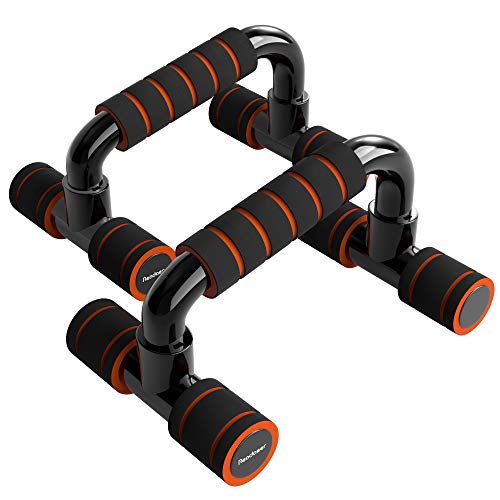
The READAEER pair is a compact fixed stand with a long, cushioned foam grip. The handle runs most of the length of the stand, which spreads pressure across the palm and gives some freedom to shift hand placement forward or back. The base is a sturdy plastic structure with a non-slip design, and the bright color options make the pair easy to spot in a shared training space.
This is a light, simple design aimed at everyday floor workouts at home or while traveling. The listing’s specification fields are inconsistent about weight capacity, so treat that figure as unconfirmed and check the listing directly if you are a heavier user. Basic assembly is required and detailed instructions are not provided, though the construction is straightforward. For moderate-volume training where grip comfort matters more than maximum capacity, the foam-covered handle is the reason to pick this pair.
Specs
- Handle type: Fixed, cushioned foam grip
- Dimensions: 5.5 x 4.7 x 8.7 inches per the listing
- Part number: YDHW-002-A3
- Brand: READAEER (manufacturer listed as Readaeer)
- Stated weight capacity: Confirm on the listing (fields conflict)
- Assembly: Basic assembly required; sold as one pair
How to Choose
Start with the rotating-versus-fixed decision. Rotating handles, like the two Perfect Fitness models, let the hand angle change during the rep, which many people find more comfortable for the wrist and shoulder. Fixed stands, like the Kipika, Redipo, and READAEER pairs, feel more planted and predictable, and there is no mechanism to wear or get gritty over time.
Next, look at the base. A wide pad or treaded base matters most on hard, smooth floors; on carpet, almost any stand will stay put but may rock slightly. Handle height controls depth: stands around 4 to 5 inches add a modest stretch at the bottom, while taller bars move toward parallette territory. Check the stated weight capacity against your body weight plus any vest you train with, and read the figure as a ceiling. Finally, consider grip diameter and padding: thicker, softer grips spread pressure for longer sets, while slimmer hard grips feel more direct.
Who Should Skip
Push up bars are not for everyone. If you have an existing wrist, elbow, or shoulder injury, check with a qualified professional before loading the joint in a new position; a different grip angle changes the stresses involved. If your goal is dips, L-sits, or handstand work, low push up stands are the wrong tool, and parallettes or a dip station will serve you better. Beginners who cannot yet complete a few controlled floor push-ups may get more from incline push-ups against a counter while they build baseline strength. And if your floor push-ups already feel comfortable and you train at moderate volume, a pair of bars is an optional refinement rather than a necessity.
FAQ
Do push up bars make push-ups harder or easier?
Both effects are possible. The raised handles let the chest travel deeper, which increases the range of motion and can make each rep more demanding. At the same time, the neutral grip is more comfortable for many wrists than a flat palm on the floor, which can make sets feel easier to complete. The net effect depends on the person and the handle height.
Are rotating or fixed push up bars better for beginners?
Fixed stands are usually the simpler starting point because the grip never moves, so there is one less thing to control. Rotating handles can feel more natural once you are used to them, but they add a small learning curve. A beginner with wrist discomfort may still prefer a rotating model; starting with low rep counts helps either way.
Can push up bars be used on carpet?
Yes, with a caveat. Stands stay in place well on carpet, but soft pile can let a narrow base tilt slightly under load. A wide, flat pad like the Kipika design spreads the contact area and feels steadier on soft surfaces. On hard floors, check that the base has rubber padding or treads so the stands do not slide mid-rep.
How much weight can push up bars hold?
It varies widely by model. In this roundup, stated capacities range from 300 pounds for the Redipo stands to a stated 1,000 pounds for the Kipika pair, with the Perfect Pushup Elite rated at 400 pounds. Treat the maker’s figure as a maximum ceiling, add your body weight and any extra load together, and confirm the current figure on the listing before buying.
Final Verdict
For most home trainers, the Perfect Pushup Elite is the pair to buy first: smooth bearing rotation, a wide stable base, and a clear 400-pound stated capacity. The original Perfect Pushup Rotating covers the same idea in a simpler form. Among fixed stands, the Kipika pair stands out for its full-size anti-slip pad and high stated capacity, the Redipo stands suit lighter portable use, and the READAEER pair is the pick when a long foam grip matters most.