Key takeaways
- Compare five vibrating foam rollers on speed settings, battery life, size and surface texture, plus charging style, to find a fit for home training.
- Top Pick: Hyperice Vyper 3 Vibrating Foam Roller
- Runner-up: Therabody WaveRoller Vibrating Foam Roller
- Also consider: TriggerPoint GRID Vibe Plus Four-Speed Vibrating Foam Roller
A vibrating foam roller works like a standard roller, with one addition: a rechargeable motor inside the body adds vibration while you roll. Supporters of the format like being able to change intensity without changing how much body weight they put through the roller, and the settings make it easier to keep pressure consistent from one area to the next.
The trade-offs are just as clear. A motor and battery add weight, every model here needs charging, and prices sit well above plain foam. This guide compares five current models on the things that actually differ between them: size, number of speed settings, surface texture, battery life and charging style, so you can match a roller to the space and routine you have.
As an Amazon Associate, we earn from qualifying purchases.
Quick Answer
The best vibrating foam rollers add a rechargeable motor to a firm foam body, with three to five speed settings depending on the model. The Hyperice Vyper 3 and Therabody WaveRoller suit buyers who want app-guided routines, while the FITINDEX five-speed model is the compact, lower-cost route. Size, surface texture and charging style matter more than top speed.
1. Hyperice Vyper 3 Vibrating Foam Roller
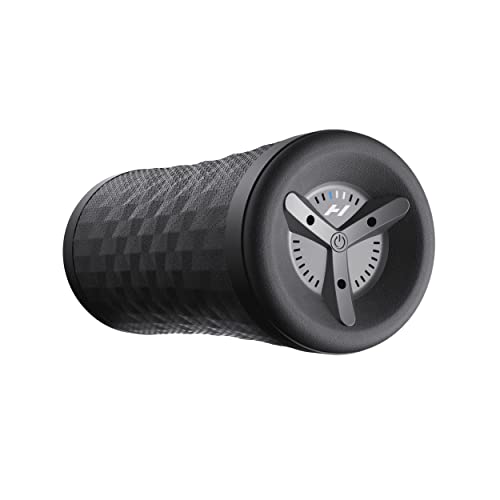
The Vyper 3 is the high-intensity option in this group. It uses a contoured polypropylene body that narrows in the middle rather than a straight cylinder, a shape Hyperice says is intended to reduce direct contact along the center of the back. Three vibration speeds are controlled from the end of the roller, and the built-in motor is rated at 34W, the highest output figure listed among these five models.
Bluetooth pairing connects the roller to the Hyperice app for guided routines, although every setting also works from the roller itself. The battery is listed at up to two hours depending on speed, and charging is through a supplied wall charger rather than USB. At 13 inches long it is a mid-size roller: long enough for both legs or most of the back, short enough to store in a closet corner.
Specs
- Length: 13 inches
- Diameter: 5.4 inches
- Vibration settings: 3 speeds
- Motor: 34W high-torque
- Battery life: up to 2 hours, depending on speed
- Body: contoured polypropylene
- Connectivity: Bluetooth, Hyperice app
- Charging: wall charger included
- Travel: listed as TSA carry-on approved
- Weight: confirm on the listing
2. Therabody WaveRoller Vibrating Foam Roller

The WaveRoller takes a different approach to the surface. Its high-density EVA foam is molded with wave-shaped grooves that run across the body, so the texture changes contact as you move without the tall ridges of a deep-tissue roller. Five vibration settings give it the widest range of adjustment in this group, and the settings can be changed on the end cap or through the Therabody app over Bluetooth.
At 12 inches long and 5 inches across, it is a mid-length roller aimed at large muscle groups such as the back, glutes and legs. Therabody lists 180 minutes of battery life from the internal lithium-ion battery, the longest runtime figure here. It is also the heaviest pick at 3.3 pounds, which is worth knowing if you plan to carry it to a gym. A protective carrying pouch and a power adapter are included in the box.
Specs
- Size: 12 x 5 inches
- Vibration settings: 5
- Surface: high-density EVA foam with wave texture
- Battery life: 180 minutes
- Battery type: internal lithium-ion
- Weight: 3.3 pounds
- Connectivity: Bluetooth, Therabody app
- Included: carrying pouch, power adapter
3. FITINDEX Vibrating Foam Roller for Exercise, 5 Vibration Speeds, Rechargeable
The FITINDEX five-speed model is the compact and lower-cost entry in this roundup. At 11.4 inches long and 4.7 inches in diameter, it is the shortest full cylinder here, which makes it easier to pack and to position under one leg or along one side of the back. The surface uses a three-density wave pattern, so different zones of the roller feel firmer or softer as you shift position.
Five vibration speeds match the WaveRoller on setting count. Charging is over USB-C, the same cable type used by many phones, which suits travel better than a dedicated wall adapter. The listing gives more than two hours of use at the highest setting, with a full charge taking about five hours, so overnight charging fits this model best. For buyers who want to try vibration without committing to a premium brand, this is the natural starting point in the group.
Specs
- Size: 11.4 x 4.7 inches
- Vibration settings: 5 speeds
- Surface: three-density wave texture
- Charging: USB-C
- Battery life: more than 2 hours at the highest setting, per the listing
- Charge time: about 5 hours
- Weight: confirm on the listing
4. TriggerPoint GRID Vibe Plus Four-Speed Vibrating Foam Roller

The GRID Vibe Plus builds vibration into the familiar GRID format. The high-density EVA foam surface carries the same kind of multi-density pattern as the standard GRID rollers, with flatter zones and firmer ridges side by side, and the 12-inch length keeps it in the mid-size class. Four vibration speeds sit between the three-speed and five-speed models in this guide.
Battery life is listed at up to two hours from the rechargeable battery, and an AC charger is included in the box. TriggerPoint backs the roller with a one-year limited warranty, a detail most rivals here do not state as clearly. If you already like the feel of a standard GRID roller and want the same surface with vibration added, this is the most direct upgrade path in the group.
Specs
- Length: 12 inches
- Vibration settings: 4 speeds
- Material: high-density EVA foam
- Surface: multi-density GRID pattern
- Battery life: up to 2 hours
- Charging: AC charger included
- Warranty: one-year limited warranty
5. TriggerPoint CHARGE VIBE Three-Speed Ridged Vibrating Portable Foam Roller
The CHARGE VIBE is the small specialist of the group. At just 7 inches long and 4 inches in diameter, it is closer in size to a water bottle than a full roller, and it is meant for targeted work on areas a long roller handles awkwardly, such as calves, forearms, the neck area and the soles of the feet. Opposing ridge curves shape the surface instead of a smooth cylinder.
Three vibration speeds keep the controls simple, and the rechargeable battery is listed at up to two hours. At about two pounds it is light enough to live in a gym bag full time. The obvious limitation is coverage: a 7-inch roller is a poor tool for the full back or both thighs at once, so it works best as a second roller alongside a standard full-size model rather than as your only one.
Specs
- Size: 7 x 4 inches
- Vibration settings: 3 speeds
- Surface: ridged design with opposing curves
- Battery life: up to 2 hours
- Weight: about 2 pounds
- Focus: compact, portable format for smaller areas
How to Choose a Vibrating Foam Roller
Start with length, because it decides what you can roll comfortably. Rollers around 11 to 13 inches cover most legs, glutes and upper-back work and store easily. Compact models near 7 inches are precision tools for calves, forearms and feet, not replacements for a full roller. If you want to roll both legs at once or lie along the roller, look at the longer end of the range and check the diameter too, since a wider diameter changes how much pressure the roller applies.
Next, look at the surface. Smooth or gently waved textures spread pressure over a wider area, while ridged and multi-density patterns concentrate it. Beginners usually get on better with a smoother surface and lower settings, then move to firmer textures only if they still want more intensity. Speed settings matter less as a headline number than as usable range: three well-spaced settings cover most needs, and five settings mainly add finer steps at the low end.
Battery and charging decide how the roller fits your week. Listed runtimes here run from about two hours to three hours, which translates to many short sessions per charge. USB-C models charge from the same cable as a phone, which is convenient for travel, while wall-adapter models often charge without tying up a USB port. Finally, consider weight. Every vibrating roller is heavier than plain foam, and the difference between two and three-plus pounds is noticeable in a gym bag.
Who Should Skip a Vibrating Foam Roller
Skip this category if a plain foam roller already does everything you need. Vibration adds cost, weight and a battery to maintain, and a standard high-density roller covers the same basic movements for far less money. Skip it as well if you dislike device upkeep: a roller that sits uncharged in a closet delivers nothing, and lithium batteries slowly lose capacity over the years.
A vibrating roller is also the wrong purchase if you are dealing with a current injury, unexplained pain, numbness or a condition your clinician is managing. These are general fitness tools, not treatment devices, and no roller in this guide is a substitute for medical assessment. If any of that applies, get professional guidance first and consider a plain roller or a massage ball under supervision instead.
FAQ
How is a vibrating foam roller different from a standard foam roller?
The body, size and rolling technique are the same. The difference is a built-in motor that adds vibration while you roll, with several intensity settings to choose from. That motor also adds weight, cost and charging to the routine, which a plain foam roller never needs.
How long does the battery last on a vibrating foam roller?
Listed runtimes in this group run from about two hours to three hours per charge, depending on the model and the speed used. Higher settings drain the battery faster. In practice, short sessions of ten to fifteen minutes mean most models go weeks between charges.
Which size should a beginner choose?
A mid-length roller of 11 to 13 inches is the most versatile starting point, since it covers legs, glutes and most back work while staying easy to store. Very short rollers are specialists for small areas, and they make a better second purchase than a first one.
Can a vibrating foam roller replace a standard roller?
For most rolling routines, yes, because the shape and technique are identical and the vibration can simply be switched off. The compromises are weight, price and battery upkeep. Many owners keep an inexpensive plain roller as a backup for travel or for days the battery is flat.
Final Verdict
For most buyers, the Therabody WaveRoller is the balanced pick: five settings, the longest listed battery life and a waved surface that stays manageable for beginners. The Hyperice Vyper 3 suits buyers who want the strongest listed motor and a contoured body. The FITINDEX five-speed model is the sensible first step into the category, the GRID Vibe Plus fits existing GRID fans, and the CHARGE VIBE earns its place as a compact second roller. Match the size to the areas you actually roll, and any of the five will do its job.