Key takeaways
- Compare the best weighted vests for walking, running and bodyweight training, covering load ranges, removable weight packs, fit, closures and pockets.
- Top Pick: ZELUS Weighted Vest with Reflective Stripe
- Runner-up: CAP Barbell Adjustable Weighted Vest, 20 lb
- Also consider: ZFOsports 40LBs Adjustable Weighted Vest
A weighted vest adds load to movements you already know: walking, stair climbing, push-ups, squats, lunges and pull-ups. Instead of holding dumbbells, the weight sits on your torso, split between the front and back panels, so your hands stay free and the load moves with your body. Vests come in two broad designs. Fixed vests are filled with iron sand or steel shot to one set weight, while adjustable vests use removable packs so you can start light and add load in small steps as your training progresses.
Choosing between them comes down to how you plan to train. A walker who wants one steady load for daily miles needs something different from a calisthenics athlete adding weight to dips and pull-ups month after month. Fit matters just as much as the number on the label: a vest that bounces, rides up or digs into the shoulders will not get worn, whatever its maximum load. The five vests below cover both designs, from a light fixed vest for walking to a heavy adjustable model built for long-term progression.
As an Amazon Associate, we earn from qualifying purchases.
Quick Answer
For most people, an adjustable vest with removable weight packs is the safer buy, because you can start well below the maximum and add load gradually. The RUNmax Run Fast and CAP Barbell vests below adjust in small steps, the ZFOsports model reaches a heavier ceiling, the Aduro Sport covers a mid-to-heavy range, and the ZELUS is a simple fixed-weight option for walking and general conditioning.
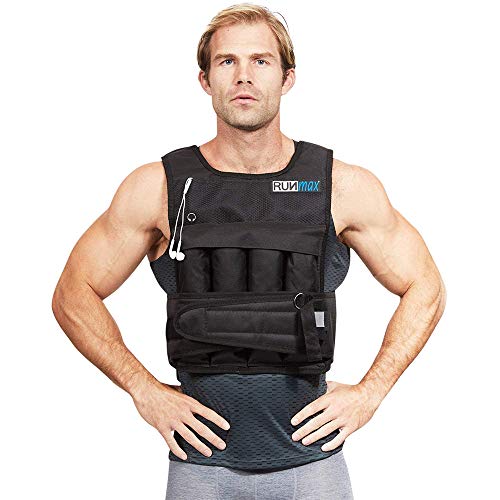
RUNmax Run Fast Weighted Vest, 20 lb
The RUNmax Run Fast is a long-running adjustable design built around removable weights. The 20 lb version listed here ships without shoulder pads and uses a hook closure with an adjustable strap, so the vest pulls in close to the torso rather than hanging from the shoulders alone. RUNmax sells the same shell in versions with higher maximum loads, and each version has its own ceiling, so the number in the title is the most this particular vest can carry. Weights sit in both the front and back panels and can be taken out at any time, which makes it easy to run the vest light for walking and heavier for strength work.
Specs
- Load: 20 lb maximum on this version, removable weights
- Shell material: nylon
- Closure: hook closure with adjustable strap
- Item dimensions: 14 x 12 x 2 inches, per the listing
- Shoulder pads: not included on this version; a padded version is sold separately
- Fit range and strap measurements: confirm on the listing
ZELUS Weighted Vest with Reflective Stripe

The ZELUS is a fixed-weight vest, filled with iron sand and sewn into a neoprene shell with double stitching. Because the fill is distributed evenly through the vest rather than concentrated in a few pockets, it sits close and moves less during walking, jogging and circuit work. There is nothing to add or remove: you choose the weight when you buy, from sizes that run from 6 lb up to 30 lb, and that is the load you train with. Adjustable elastic straps fine-tune the fit around the torso, and a reflective stripe runs across the vest for low-light visibility on early or late walks.
Specs
- Load: fixed weight, sizes from 6 lb to 30 lb
- Fill: iron sand, evenly distributed
- Shell material: neoprene with double stitching
- Fit: adjustable elastic straps
- Visibility: reflective stripe
- Weight adjustability after purchase: none; confirm your size choice on the listing
Aduro Sport Adjustable Weighted Vest, 26 to 46 lb
Aduro Sport sells its vest in several weight ranges, and this version covers the heavier end, adjusting between 26 and 46 lb with removable weight packs. The shell is neoprene with a hook-and-loop closure, so the vest wraps and fastens rather than pulling over the head, which helps when the vest is loaded. This range suits experienced trainees who already know they want substantial load for weighted calisthenics, loaded carries or rucking, and who would outgrow a 20 lb vest quickly. Beginners should look at the lighter ranges instead, since the minimum load here is already more than many people should start with.
Specs
- Load: adjustable from 26 lb to 46 lb on this version
- Weight system: removable weight packs; pack count and pack size, confirm on the listing
- Shell material: neoprene
- Closure: hook-and-loop (Velcro)
- Part number: S-WAV-26-46LB
- Intended users, per the listing: men, women and older kids; check the maker’s age guidance on the listing
CAP Barbell Adjustable Weighted Vest, 20 lb

CAP Barbell’s 20 lb vest adjusts in some of the smallest steps in this group. The load is made up of removable steel-shot packets of roughly one pound each, twenty in total, so you can run the vest at almost any load from a single pound up to the full 20 lb. That granularity suits structured progression, where the plan calls for adding a small amount of weight at a time to push-ups, squats or step-ups. The vest is a single black, one-size design with adjustable straps, and the packets slide into pockets around the torso so the weight stays spread out rather than stacked in one place.
Specs
- Load: adjustable from about 1 lb to 20 lb
- Weight system: removable steel-shot packets, approximately 1 lb each, 20 packets
- Color: black
- Model: HHWV-CB020C
- Fit: one size with adjustable straps; exact fit range, confirm on the listing
- Shell material: confirm on the listing
ZFOsports 40LBs Adjustable Weighted Vest
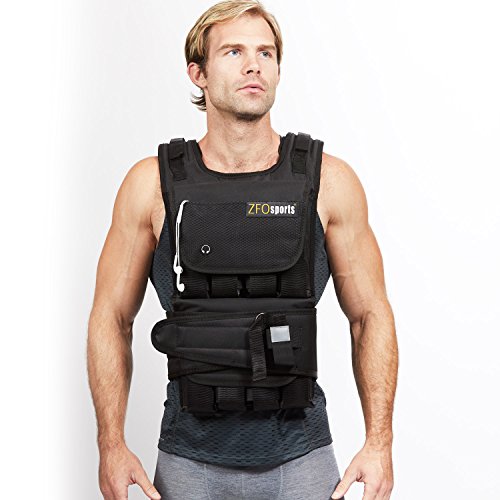
The ZFOsports vest is a heavier nylon model that adjusts up to 40 lb, aimed at trainees who want one vest for both conditioning and loaded strength work. It fastens with hook-and-loop closures and adjustable straps, and it adds two practical extras the other vests here do not list: a pocket for a phone or music player and a water bottle holder, which makes it easier to carry the essentials on longer rucking or walking sessions without a separate belt or pack. Weight is added and removed through the vest’s pockets, so the load can be scaled back for technique work and built up for heavier sessions.
Specs
- Load: adjustable up to 40 lb
- Shell material: nylon
- Closure: hook-and-loop (Velcro) with adjustable straps
- Extras: phone or music pocket and water bottle holder, per the listing
- Part number: zfo_40
- Weight pack size and count: confirm on the listing
How to Choose
Start with the load range, not the maximum. Pick a vest whose range brackets the load you will actually use in the next few months: beginners generally start light, with a small load they can move well with, and progress gradually under the guidance of their own program or coach. An adjustable vest with small increments, like the CAP Barbell’s one-pound packets, makes that progression easier to manage than a fixed vest or one with large jumps between settings.
Next, match the design to the activity. Fixed iron-sand vests like the ZELUS sit close and suit walking, jogging and general conditioning. Removable-pack vests suit strength-focused training, where the load changes between exercises. Check the closure and fit system: hook-and-loop wraps and adjustable straps should hold the vest snug enough that it does not bounce when you move, and shoulder construction matters more as loads climb, so heavier trainees should look at padded options. Finally, confirm the details that vary between versions of the same product, such as pack count, fit range and whether shoulder pads are included, on the listing before ordering.
Who Should Skip
Skip a weighted vest if you have a current injury, joint problems, back or neck issues, balance concerns, or any medical condition that added load could aggravate, and talk to a medical professional before training with one if you are unsure. Skip the heavy ranges entirely if you are new to loaded training; a 40 lb vest is a tool for experienced users, not a starting point. Children should only use a vest where the maker explicitly supports it and under adult supervision. And if your training is mostly heavy barbell work, a vest adds little: it is a bodyweight and conditioning tool, not a replacement for a rack and plates.
FAQ
How much weight should a beginner start with?
Start at the light end of whatever vest you choose, with a load you can walk and move in with good form, and build up slowly over weeks. Follow the progression in your own training program, and stop and reassess if a load changes how you move. If you have any health concerns, get medical guidance first.
Can you run in a weighted vest?
Some people do, but running multiplies the impact through your joints compared with walking. If you run in a vest, keep the load light, choose a close-fitting design that does not bounce, and build distance gradually. Walking and rucking are the lower-impact way to use the same equipment.
What is the difference between fixed and adjustable vests?
A fixed vest is sewn or filled to one weight, like the iron-sand ZELUS, so you pick the load when you buy it. An adjustable vest uses removable packs or packets, so one vest covers a range of loads and can progress with you. Fixed vests tend to sit closer; adjustable vests are more versatile.
How should a weighted vest fit?
It should sit snug against the torso, high enough that the bottom edge does not bang against your hips, with the weight balanced between the front and back panels. Straps and closures should hold it in place without restricting breathing. If it bounces, slides or pulls on one shoulder, adjust the fit or size down the load.
Final Verdict
For a first vest that can grow with your training, the RUNmax Run Fast and CAP Barbell adjustable models are the most flexible picks here, with the CAP offering the finest load increments. The ZFOsports suits experienced trainees who want a higher ceiling plus carry pockets, the Aduro Sport covers a heavy range in a wrap-around neoprene shell, and the ZELUS is the simple choice for walkers who want one fixed, close-fitting load. Whichever you choose, start lighter than you think you need to, progress gradually, and follow your own program and medical guidance.