Key takeaways
- Compare the best wobble boards for home training, standing desks and ankle work, with deck sizes, base styles and weight limits for each pick.
- Top Pick: Yes4All Professional Rocker Balance Board
- Runner-up: ProsourceFit Wooden Balance Board
- Also consider: HAPOO Wooden Wobble Board for Adults
A wobble board is one of the simplest pieces of training equipment you can own: a flat deck on an unstable base that asks your ankles, legs and trunk to make constant small corrections while you stand on it. The category splits into two main shapes. Rocker boards tilt in one plane, forward and back or side to side, which keeps the movement predictable. Round wobble boards sit on a dome or ball base and can tip in any direction, which makes them noticeably harder to control.
This guide compares five wobble boards that cover both styles, from a wooden rocker board suited to gentle ankle work to a long desk board built for standing desks. Each pick lists only the specifications shown in its listing, such as deck size, material and stated weight limit, so you can match a board to your floor space, your footwear and the kind of sessions you have in mind.
As an Amazon Associate, we earn from qualifying purchases.
Quick answer
For most beginners, a wooden rocker board such as the Yes4All Professional Rocker Balance Board is the easiest starting point because it moves in one direction at a time. For a board that tips in every direction, look at the ProsourceFit or HAPOO wooden boards. The Gaiam Evolve suits standing desks, while the Yes4All Plastic Wobble Balance Board is a lighter round option.
1. Yes4All Professional Rocker Balance Board

The Yes4All Professional Rocker Balance Board is a wooden rocker board, which means the deck sits on a curved base and tilts in a single plane. That one-direction movement is what makes rocker boards the usual first step for people who are new to unstable-surface training: you can hold a wall or chair back, rock slowly, and increase the range of motion over time. The rectangular deck gives your feet a clear front and back edge to read, and the listing describes it for balance work, leg exercises and standing desk use.
Because the board only rocks one way, it also suits short, controlled ankle mobility drills where a full 360-degree board would move more than a beginner wants. If you later find the single-plane motion too easy, this style of board still works for calf raises and single-leg stands with a narrower stance.
Specs
- Material: wood, per the listing
- Deck size: 17.5 x 13.5 inches, 3 inches high
- Maximum weight recommendation: 350 pounds, per the listing
- Model name: R7TM4
- Warranty: 1-year warranty, per the listing
2. ProsourceFit Wooden Balance Board

The ProsourceFit Wooden Balance Board is the classic round wobble board format: a circular wooden deck on a rounded base that allows 360-degree rotation, so the deck can tip toward any point of the compass. That freedom is the main difference from a rocker board. Movements such as squats, planks with hands on the deck, and single-leg stands all become harder because the board does not settle into one predictable groove.
The deck diameter is in the standard range for this style, wide enough for a two-foot stance and compact enough to store against a wall. The listing positions it for stability training, full-body exercises and physical therapy settings. Start near a support surface, because a round board can roll out from under a beginner faster than a rocker can.
Specs
- Material: solid wood and PP plastic, per the listing
- Deck size: 15.75 inches in diameter
- Maximum weight recommendation: 300 pounds, per the listing
- Board weight: about 3 pounds, per the listing description
- Part number: ps-1086-wbb-blue
3. HAPOO Wooden Wobble Board for Adults

The HAPOO board is another wooden design, but with a rectangular deck and a lower profile than the round boards in this guide. A lower deck height means a smaller tipping range before the edge of the board meets the floor, which many adults prefer for standing desk sessions and for gentle side-to-side or front-to-back rocking at home. The listing describes a non-slip top surface, which matters if you plan to use the board in socks or bare feet.
Its stated weight limit is among the higher figures in this roundup, and the deck footprint is close to the Yes4All rocker, so the choice between the two comes down to base shape and how much tilt you want rather than size. Check the listing photos to see the base profile before you order.
Specs
- Material: wood, per the listing
- Deck size: 16.5 x 13 x 2.5 inches
- Maximum weight recommendation: 350 pounds, per the listing
- Model number: BALANCE BOARD-1
- Base style: confirm on the listing
4. Gaiam Evolve Balance Board
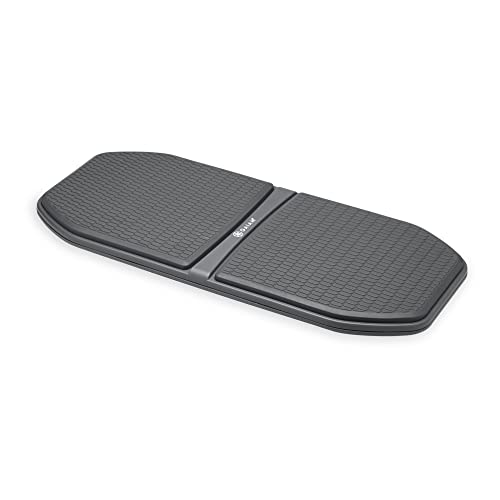
The Gaiam Evolve takes a different approach from the wooden boards above. It is a long rocker board made for standing desks, designed so you can stand on it for extended periods and shift your weight in a slow, controlled rocking motion while you work. The deck materials are synthetic rather than wood, and the overall shape is closer to a wide platform than to a therapy-style disc.
This is the pick to consider if your goal is gentle movement during the workday rather than dedicated balance drills. The stated weight limit is the lowest in this guide, so heavier users should look at the wooden options instead. Because it is built for desks, the rocking range is modest, and experienced balance trainers will likely find it too tame for workout use.
Specs
- Material: PU, PVC and TPR, per the listing
- Item weight: 6.5 pounds
- Maximum weight recommendation: 250 pounds, per the listing
- Model name: Evolve
- Deck dimensions: confirm on the listing
5. Yes4All Plastic Wobble Balance Board

The second Yes4All entry in this guide is a round plastic wobble board, a lighter and usually simpler alternative to the wooden discs. The deck sits higher than the wooden round boards listed here, which gives it a larger tipping range in every direction. A taller base cuts both ways: there is more room to challenge yourself, and more distance to fall back to the floor when you lose the position, so beginners should keep a hand near a counter or rack.
Plastic construction makes this style easy to wipe down and carry between rooms, and the listing describes it for core training, home gym workouts and standing desk use. If you want one board shared by several people at different levels, the round format lets each user choose their own stance width and difficulty.
Specs
- Material: plastic, per the listing
- Deck size: 15.75 x 15.75 inches, 4 inches high
- Model name: T3VS
- Warranty: 1-year warranty, per the listing
- Maximum weight recommendation: confirm on the listing
How to choose
Start with the base style, because it decides how the board behaves under your feet. Rocker boards tilt in one plane and are the most forgiving choice for beginners, older adults, and anyone doing slow ankle mobility work. Round wobble boards tip in every direction and suit people who already have some experience with unstable surfaces.
Next, check deck size against your stance. Most adults are comfortable on decks between about 13 and 17.5 inches in their longest dimension. If you plan to do two-foot squats on the board, stay toward the larger end. For standing desk use, look for a longer rocker deck and a modest tilt range, since you will be on the board for long stretches rather than short sets.
Then compare the stated weight limit with your body weight plus anything you might hold during exercise, and leave a margin rather than buying a board you are right at the limit of. Finally, think about the floor underneath. Hard bases can mark wood floors and are noisy on tile, so many people place a mat under the board; a mat also slows the board slightly, which can help during the first weeks.
Who should skip
Skip wobble boards entirely if you have been told by a clinician to keep weight off an ankle, knee or hip, or if you are recovering from a recent lower-body injury and have not been cleared for unstable-surface exercise. A wobble board is a training tool, not a medical device, and this guide makes no claims about rehabilitation outcomes.
Also skip the tall round boards if your balance is currently poor and you have no stable support to hold while you practice. Beginners with limited space should pass on the long desk board, and anyone who wants heavy loaded exercise, such as weighted squats, should choose equipment designed for that purpose instead of a balance board.
FAQ
Are wobble boards and rocker boards the same thing?
Not exactly. A rocker board tilts in one direction, forward and back or side to side, because its base is a curved rail. A round wobble board sits on a dome or ball base and can tip in any direction, which makes it harder to control. Both are sold as balance boards, so check the base shape in the listing before you buy.
How long should a beginner session last?
Short sessions are the sensible starting point. Many people begin with a few minutes of supported standing, holding a wall or chair, and add time gradually as the movement feels more controlled. Stop when your ankles or calves are fatigued, since tired legs make your form sloppy. Follow any guidance your own clinician or trainer has given you.
Can I use a wobble board at a standing desk?
Yes, and long rocker boards such as the Gaiam Evolve are made for exactly that. Desk boards use a gentler rocking range than workout boards so you can shift your weight while you type. Keep your regular floor space clear behind you, and step off the board when you need to concentrate on something that requires standing still.
What floor surface works best under a wobble board?
A flat, hard floor gives the most predictable movement. Thick carpet slows the board and can make a rocker base feel uneven, while a thin exercise mat adds grip and protects hard floors from marks. Avoid using a wobble board on loose rugs, which can slide out from under the base.
Final verdict
The right wobble board depends on how much instability you actually want. Choose the Yes4All Professional Rocker Balance Board for a controlled, one-direction start, the ProsourceFit or HAPOO wooden boards for all-direction training at home, the Gaiam Evolve for gentle standing desk movement, and the Yes4All Plastic Wobble Balance Board if you prefer a lightweight round deck. Whichever you pick, start near a support, keep sessions short, and progress at your own pace.