Key takeaways
- Compare the best forearm trainers for home workouts, from plate-loaded wrist rollers to a gyro ball, with specs, buying tips, and FAQ answers.
- Top Pick: Yes4All Wrist and Forearm Blaster
- Runner-up: FitBeast Forearm Strengthener and Wrist Roller
- Also consider: AJKPL Forearm Strengthener and Wrist Roller
Forearms are easy to neglect in a home gym. Rows, deadlifts, and carries ask a lot of them, but few common tools load the wrist flexors and extensors directly through a full range of motion. That gap is exactly what forearm trainers are built to fill. They are small, single-purpose devices that train wrist flexion, wrist extension, and forearm rotation using weight plates, springs, body position, or gyroscopic resistance.
This guide compares five different designs: a cradle-style developer you rock back and forth, two plate-loaded wrist rollers, a webbing roller with a quick-locking strap, and a gyroscopic ball that needs no weights at all. Each one suits a different training space and a different way of progressing. Read the specs carefully, because plate fit, handle size, and resistance style matter more here than brand names.
As an Amazon Associate, we earn from qualifying purchases.
Quick Answer
The best forearm trainers are simple tools that load wrist flexion and extension: plate-loaded wrist rollers like the Yes4All and FitBeast blasters, the cradle-style Marcy Forearm Developer, a webbing roller from AJKPL, and the NSD gyro ball. Match the design to your space, your plates, and how you prefer to progress resistance over time.
1. Marcy Wrist and Forearm Developer/Strengthener (WEDGE)
The Marcy WEDGE takes a different approach from every roller in this guide. Instead of winding a cord, you rest your forearm in a padded cradle, grip the handle, and rock the device back and forth. That single rocking motion works the top and underside of the forearm in one set, so there is no need to reverse a strap or change your grip between flexion and extension work.
Resistance comes from a dial on the unit. Turning it raises the tension as you rock, which makes progression straightforward for beginners: start light, finish a clean set, and add a small amount next session. Sliding knobs on the cradle adjust the grip position to match different arm and hand lengths, a useful detail if more than one person will share it. The footprint is compact enough for a desk drawer or gym bag, and the unit sits flat on a bench, couch arm, or table while you train.
Specs
- Model: WEDGE, made by Impex Inc. under the Marcy brand
- Design: cradle-style forearm developer with a rocking motion
- Resistance: variable resistance dial, adjusted by turning
- Fit: padded foam forearm cradle with sliding grip adjustment knobs
- Dimensions: 14.5 x 8 x 6 inches as listed in the product description
- Warranty: 2-year limited manufacturer warranty as listed
- Included: forearm developer, user manual, warranty card
2. Yes4All Wrist and Forearm Blaster

The Yes4All Blaster is the classic wrist roller format: a solid steel bar with foam grip handles and a nylon webbing rope that wraps around the center. You load plates onto the strap, hold the bar at arm’s length or rest your forearms on a bench, and roll the weight up and down under control. It trains flexion on the way up and extension when you reverse your grip.
Because the load comes from your own plates, progression is as granular as your plate collection allows, and the listed capacity of 100 lbs leaves room to grow. The bar accepts both 1-inch standard plates and 2-inch Olympic plates, which makes it one of the more flexible rollers for mixed home gyms. Soft foam handles reduce hand fatigue during longer sets, though lifters with very large hands should check the handle length figure below before ordering.
Specs
- Design: plate-loaded wrist roller with nylon webbing rope
- Construction: solid steel bar with soft padded foam grip handles
- Plate fit: 1-inch standard and 2-inch Olympic weight plates, plates not included
- Weight capacity: 100 lbs as listed
- Dimensions: 14.8 x 1.3 inches as listed
- Handle length: 5.7 inches as listed
- Product weight: 1.5 lbs as listed
- Part number: SJCT
3. FitBeast Forearm Strengthener and Wrist Roller
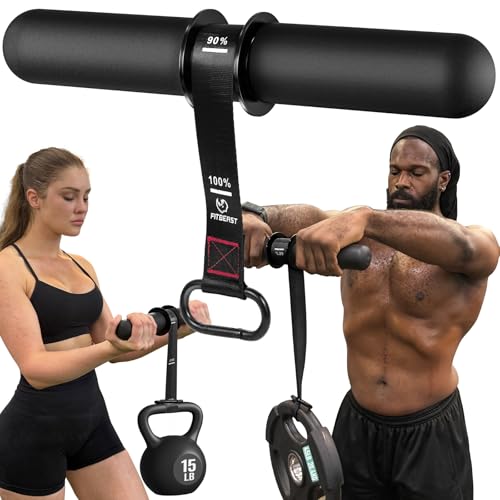
FitBeast’s roller follows the same plate-loaded concept but is built around a thicker handle. A fatter grip spreads the load across the hand and asks more of the fingers and flexors during each roll, which some lifters prefer for grip-focused work. The adjustable strap lets you set the hanging length, so you can roll standing with straight arms or seated with your forearms supported.
The listing states a weight capacity of 240 lbs, well beyond what most people will ever hang from a wrist roller, so the ceiling is unlikely to be the limiting factor. Anti-slip handles are intended to keep the bar from twisting in sweaty palms during slow eccentric lowering, which is where much of the training effect sits. If you already own plates and want a roller that emphasizes grip thickness, this is the design to look at first.
Specs
- Design: plate-loaded wrist roller with a thicker handle
- Strap: adjustable strap for setting the hanging length
- Handles: ergonomic anti-slip handles as listed
- Weight capacity: 240 lbs as listed
- Color: black
- Model number: SBXLQ-Black
- Plate size compatibility: confirm on the listing
4. AJKPL Forearm Strengthener and Wrist Roller

The AJKPL roller swaps the usual cord for ultra-strong nylon webbing, offered in 43.3-inch and 51.2-inch lengths. Webbing lies flatter on the bar than a round cord, and the quick locking mechanism is designed to keep the strap from slipping mid-set, a small but real annoyance with basic rollers. Longer webbing also gives taller lifters more room to roll without the plate reaching the bar too quickly.
Anti-slip grip handles round out a straightforward package aimed at home and gym use. The box includes the blaster itself and an instruction sheet. Because the listing does not publish a maximum load figure in the details retrieved for this guide, treat the capacity as unconfirmed and check the product page if you plan to load it heavily.
Specs
- Design: wrist roller and forearm blaster with nylon webbing strap
- Webbing: ultra-strong nylon webbing, 43.3 inches or 51.2 inches as listed
- Locking: quick locking mechanism to hold the strap in place
- Handles: durable anti-slip grip handles
- Model name: forearm-003
- Included: 1 wrist and forearm blaster, 1 instruction sheet
- Maximum load capacity: confirm on the listing
5. NSD Essential Crystal Spinner Gyro Ball

The NSD Essential Spinner is the outlier here: a gyroscopic ball that fits in one hand and needs no plates, straps, or setup. You start the internal rotor with the included pull string, then rotate your wrist in small circles to keep it spinning. The faster it spins, the harder it pushes back, so resistance is self-scaling and continuous through the set.
That makes it a practical desk and travel option for people who want frequent, short forearm sessions rather than a formal workout. The listing rates the rotor at up to 18,000 RPM, and the device runs entirely on hand power with no battery to charge. Gyro balls do involve a learning curve: most beginners need a few sessions to keep the rotor going smoothly, and the motion trains endurance and coordination more than maximal strength.
Specs
- Design: gyroscopic hand exerciser ball
- Start method: string start with included pull string
- Top speed: up to 18,000 RPM as listed
- Power: no battery required, hand powered
- Brand: NSD, manufactured by NSD Power
- Resistance figure in kilograms: confirm on the listing
- Best suited to: short, frequent sessions at a desk or while traveling
How to Choose a Forearm Trainer
Start with the resistance style. Plate-loaded rollers like the Yes4All, FitBeast, and AJKPL models progress in small steps and can get genuinely heavy, but they only work if you already own weight plates in the right bore size. The Marcy WEDGE and the NSD gyro ball are self-contained, which suits beginners, small spaces, and anyone who trains away from a plate rack.
Next, think about the motion you want. Rollers and the WEDGE load wrist flexion and extension through a controlled range, which is the core of most forearm training. A gyro ball trains the same muscles isometrically and dynamically at once, with resistance that rises and falls with your rhythm rather than staying constant.
Handle fit matters more than it first appears. Thick handles shift work toward the fingers and grip; standard handles let the wrist do more of the work. Check listed handle lengths against your hand size, and look at strap or webbing length if you are tall or plan to roll while standing. Finally, consider noise and setting. A gyro ball hums as it spins, rollers need clear floor space below the plate, and the WEDGE needs a flat surface to rest on.
Who Should Skip Forearm Trainers
Skip these tools if you are currently dealing with wrist, elbow, or forearm pain, or recovering from an injury, until a clinician clears you for loaded wrist work. Forearm trainers concentrate stress on small joints and tendons, and they are a poor choice for unsupervised rehabilitation.
They are also unnecessary if your program already includes heavy carries, deadlifts, and direct wrist work with dumbbells, and your grip is not a limiting factor. And if you do not own weight plates and do not plan to buy any, the three plate-loaded rollers in this guide are the wrong picks; choose a self-contained design instead.
Frequently Asked Questions
How often should beginners train with a forearm trainer?
Two or three short sessions per week is a sensible starting point for most beginners, with at least a day between sessions. Forearm muscles and the tendons around the wrist adapt more slowly than larger muscle groups, so begin with light resistance and clean, controlled reps rather than daily maximal work.
Do wrist rollers train both sides of the forearm?
Yes, when used in both directions. Rolling the bar one way emphasizes the flexors on the underside of the forearm, and reversing your grip so the weight rolls the other way emphasizes the extensors on top. A balanced routine includes both directions in roughly equal volume.
Can a gyro ball replace plate-loaded forearm training?
Not entirely. A gyro ball builds endurance, coordination, and moderate strength with resistance that scales with spin speed, and it is excellent for frequent short sessions. Plate-loaded rollers allow heavier, measurable progression. Many lifters treat the gyro ball as a complement to, rather than a replacement for, loaded work.
What weight should a beginner hang from a wrist roller?
Start with the lightest plate you own, often 2.5 or 5 lbs, and learn the motion with full control in both directions. The load should let you complete each roll without shrugging, bending your elbows, or letting the plate drop. Add weight in the smallest steps your plates allow.
Final Verdict
For most home gyms, a plate-loaded roller is the most direct route to stronger forearms: the Yes4All Blaster stands out for its dual plate fit and listed 100 lb capacity, while the FitBeast suits lifters who want a thicker handle. The Marcy WEDGE is the friendliest starting point for beginners who own no plates, the AJKPL offers a tidy webbing-and-lock design, and the NSD gyro ball covers desk and travel training. Pick the design that matches your equipment and space, train both directions, and progress gradually.