Key takeaways
- Compare the best finger extensor trainers for balanced hands, from latex-free IronMind bands to the Handmaster Plus, with specs, buying tips and FAQs.
- Top Pick: IronMind Expand-Your-Hand Bands, 10 Pack
- Runner-up: ALPHA GRIPZ Complete Set Hand Grip Extensor Trainer
- Also consider: Airisland Finger Stretcher Hand Resistance Bands, 3 Pieces
Almost every grip tool in a home gym trains one direction: closing the hand. Grippers, deadlifts, rows and carries all load the flexor muscles on the palm side of the forearm, while the extensors that open the hand get whatever work daily life happens to give them. Finger extensor trainers exist to close that gap. They are small bands, webs and ball-and-lace systems that resist the opening motion, so the back of the forearm gets deliberate training instead of leftovers.
This guide compares five extensor trainers in the main formats on sale: classic loop bands, silicone finger webs, a wrist-strap band system and a therapy-style ball system. Each one is judged on resistance range, format and what is actually in the package, using only details the listings themselves state. None of these tools is a medical device, and none replaces advice from a clinician about an injury or a diagnosed hand condition.
As an Amazon Associate, we earn from qualifying purchases.
Quick Answer
The best finger extensor trainer for most lifters is a simple band set with several resistance levels, because extension muscles are weak and progress comes from light, frequent work. IronMind Expand-Your-Hand Bands lead on range, ALPHA GRIPZ adds squeeze rings for two-way training, and the Handmaster Plus suits therapy-style, full-range routines at home.
IronMind Expand-Your-Hand Bands, 10 Pack

IronMind makes the Captains of Crush grippers, and these bands are the same company’s answer for the other half of the motion. Each band is a plain latex-free rubber loop that sits around the closed fingers; opening the hand against it trains extension. The set is the reference point for this category and the easiest recommendation for lifters who already train crush grip and want a matched extensor tool from a specialist maker.
Specs
- Format: loop bands worn around the fingers of a closed hand
- Resistance levels: 5 color-coded levels
- Count: 10 bands, 2 of each level
- Material: latex-free rubber
- Resistance rating per level: confirm on the listing
Five levels with two bands each makes progression simple: work one band per hand, then double up or move a color as the reps get easy. The latex-free rubber also matters for buyers who react to latex, and the bands weigh almost nothing, so a set lives in a gym bag or desk drawer without thought. The trade-off is feedback: there are no pound ratings to chase, so progress is tracked by color and reps rather than numbers.
ALPHA GRIPZ Complete Set Hand Grip Extensor Trainer

ALPHA GRIPZ builds its set around silicone extensor bands with printed pound ratings, then adds squeeze rings so one package covers both directions of hand training. The bands are finger-loop webs rather than plain loops, which keeps them seated on the fingers during higher-rep sets.
Specs
- Format: silicone finger-loop extensor bands plus squeeze rings
- Resistance levels: 3 bands, rated 6, 9 and 12 pounds
- Includes: 3 extensor bands, 2 Ringz squeeze rings, carry bag
- Material: silicone
- Item weight: 6.24 ounces
The printed ratings are the appeal here: 6, 9 and 12 pounds gives a clear ladder for programming, and the two Ringz rings let a session pair extension work with light flexion work in the same sitting. Silicone wipes clean and does not absorb sweat the way plain rubber can. Buyers who need more than 12 pounds of extension resistance should note the separate X-TREME set in the same line, which adds a fourth, heavier band; the Complete Set is the better starting point for most hands.
Airisland Finger Stretcher Hand Resistance Bands, 3 Pieces
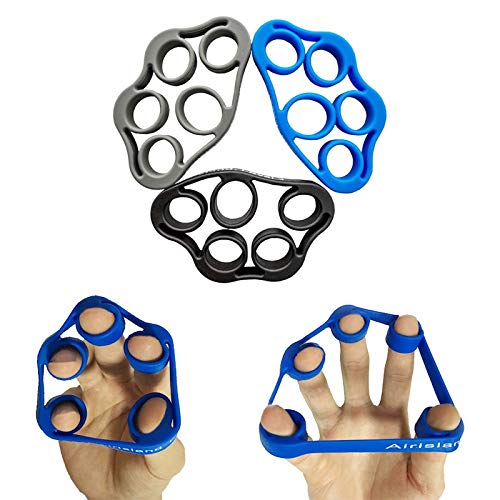
The Airisland set is the minimalist option: three silicone stretchers, each a flat piece with finger holes that you spread open against its resistance. There is no strap, no ball and no hardware, which makes it the easiest of the five to keep in a pocket or a laptop bag.
Specs
- Format: silicone finger-hole stretchers
- Count: 3 pieces
- Resistance: multiple levels across the set; exact ratings, confirm on the listing
- Material: silicone
- Best for: travel, desk use and short daily sessions
Because each piece is a single molded stretcher, there is nothing to assemble and nothing to adjust; you pick the piece that matches the day’s effort and work through your reps. The format limits fine progression compared with a five-level band set, and the holes are one size, so very large hands should check the listing’s sizing notes before ordering. For beginners who want the lowest-friction way to add extension work, that simplicity is the point.
Krdebasai Finger Extension Stretcher Exerciser

This design takes a different approach: a wrist strap anchors the unit while interchangeable silicone finger bands provide the resistance, so the fingers extend against a fixed point instead of stretching a free band. It is sold as a hand rehab and grip training tool, and the anchor design keeps the bands from slipping off mid-set.
Specs
- Format: wrist-strap anchor with interchangeable finger bands
- Tension level: 40 pounds listed for the set
- Includes: 1 finger spreader and extender unit, 10 finger stretcher bands
- Material: silicone
- Fit and sizing details: confirm on the listing
Ten spare bands in the box is practical, because individual finger bands are the wear item in any strap system. The listed 40-pound tension figure is far above what the finger extensors can move on their own and reflects the set’s combined band ratings rather than a per-rep load, so treat the number as a range marker, not a target. Start with the lightest band combination the set allows and build slowly, as with every trainer in this guide.
Handmaster Plus Hand Exerciser, 9 Piece Set
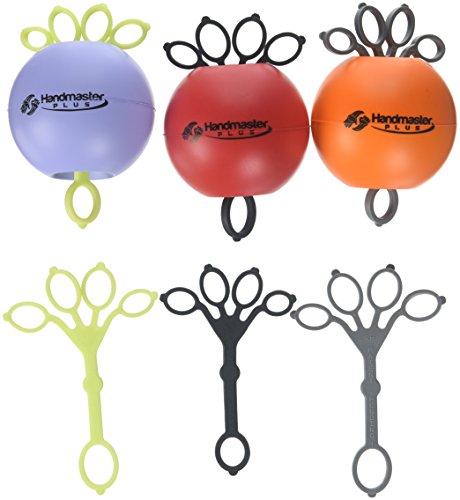
The Handmaster Plus, made by Doczac Enterprises, pairs a squeeze ball with a cord-and-lace system: you grip the ball, then open your hand against laces threaded through it, so flexion and extension happen in one continuous movement through a full range of motion. It comes out of the hand therapy world rather than the grip sport world, and it shows in the design.
Specs
- Format: squeeze ball with cord-and-lace finger extension system
- Set contents: 9 pieces, multicolored balls
- Tension: medium on this listing; soft and firm versions are sold as separate listings
- Material: thermoplastic elastomers
- Maker: Doczac Enterprises, part number 1479
This is the pick for buyers who want one guided routine instead of separate tools: squeeze, open, repeat, with the laces keeping every finger involved, including the thumb. The single-tension listing is the limitation, since progressing means buying a different tension rather than swapping a band. Anyone using it as part of recovery after an injury should follow the guidance of their own therapist rather than the box, as with any therapy-adjacent tool.
How to Choose
Start with format. Loop bands and silicone stretchers are the lightest and cheapest way in, and they suit high-rep balance work after grip sessions. A wrist-strap system keeps bands anchored for people who find free bands fiddly, while the ball-and-lace design folds flexion and extension into one movement for therapy-style routines.
Then look at the resistance ladder. Extension muscles are much weaker than the flexors, so a set that starts light and climbs in small steps will get more use than one heavy band. Printed pound ratings help programming, but color-coded levels work just as well if you track reps honestly. Finally, check the material if latex is a concern, and confirm sizing and exact ratings on the listing before ordering, since several sets leave those details to the product page.
Who Should Skip
Skip extensor trainers if you are currently being treated for a hand, wrist or elbow injury and your clinician has not cleared resistance work; these are training tools, not treatment. Skip them, too, if you only want heavier crush grip numbers and have no interest in balance work, since a dedicated gripper serves that goal better. And if your hands are unusually large, skip one-size finger-hole stretchers until you have checked the sizing on the listing.
FAQ
How often should beginners train finger extension?
Two or three short sessions a week is a sensible starting point for most people, using light resistance and controlled reps. The extensors recover quickly, but they are small muscles, and daily maximal work is unnecessary. Many lifters simply add a few sets after grip or pulling sessions.
Can finger extensor trainers replace regular grip training?
No. They train the opposite motion, so they complement grippers, deadlifts and carries rather than replacing them. A balanced hand program usually keeps crush and pinch work as the main load and uses extension work as a smaller, regular addition.
What resistance level should a first-time buyer start with?
Start with the lightest band or stretcher in the set, even if it feels easy for the first few reps. Extension strength is low for almost everyone at first, and the goal in the early weeks is clean, full-range reps. Move up a level when the top of your rep range feels controlled.
Are latex-free options available for sensitive skin?
Yes. The IronMind bands in this guide are latex-free rubber, and the silicone sets from ALPHA GRIPZ, Airisland and Krdebasai are latex-free by material. Check the listing for the exact set you order, since materials can vary between versions of similar products.
Final Verdict
For most readers, the IronMind Expand-Your-Hand Bands are the safest first purchase: five levels, latex-free, and made by the best-known name in grip training. Choose the ALPHA GRIPZ Complete Set if you want printed pound ratings and squeeze rings in one bag, the Airisland set for the simplest travel option, the Krdebasai system if free bands keep slipping off your fingers, and the Handmaster Plus for a guided, therapy-style routine. Whichever format you pick, keep the loads light, the reps controlled, and the habit regular.