Key takeaways
- Compare the best power towers for home pull-ups, dips, knee raises and push-ups, with weight capacity, height and footprint checks before you order.
- Top Pick: Sportsroyals Power Tower Pull Up Bar Station
- Runner-up: Body Champ Multi-Function Power Tower VKR1010
- Also consider: Final Verdict
A doorway pull-up bar is the cheapest way to train pulling movements at home, but it only works when the door frame is the right width, the trim is strong enough, and the wall around it can take the load. Plenty of homes fail at least one of those checks, and renters often cannot use a bar that leaves marks. A power tower solves that problem by standing on its own frame: one freestanding station that combines a pull-up bar, dip handles, a vertical knee raise station, and push-up bars in a single footprint.
The trade-off is space. A tower takes up real floor area, stands close to seven feet tall, and needs assembly before the first workout. In return, several stations stay set up all the time, with no door frame to measure and nothing mounted to a wall. This guide compares five power towers sold on Amazon and explains the capacity, height, and footprint checks that matter before ordering.
As an Amazon Associate, we earn from qualifying purchases.
Quick Answer
For most home users, the Sportsroyals Power Tower is the strongest all-round pick, with a 440 lb listed capacity, a six-level adjustable pull-up bar, and an assisted pad that folds into a backrest. The RELIFE tower suits households needing more height settings. The Weider covers the core stations at 300 lb, the Body Champ VKR1010 is a wide-based classic, and the compact Stamina 1690 fits smaller rooms.
1. Sportsroyals Power Tower Pull Up Bar Station

The Sportsroyals Power Tower is the fullest-featured tower in this group. Its pull-up bar adjusts through six height levels starting at 64.56 inches, letting shorter users reach the bar without jumping and taller users raise it for a longer hang. The frame uses an H-shaped base, 39.7 inches long with eight support points and rubber feet, designed to keep the tower planted during dips and knee raises. A padded assist pad supports the knees during assisted pull-ups and folds into position as the backrest for the knee raise station.
Specs
- Brand: Sportsroyals
- Frame: commercial steel, powder-coated finish
- Maximum weight recommendation: 440 lb, per the listing
- Pull-up bar: adjustable, 6 levels, from 64.56 in
- Assembled dimensions: 41.2 x 39.7 x 87.01 in
- Stations: pull-up, dip, vertical knee raise, push-up
- Base: H-shaped, 39.7 in long, 8 support points
This is the tower to shortlist if more than one person will train on it, or if assisted pull-ups are part of the plan while building toward full reps. Like most freestanding towers, it is built for strict, controlled movements rather than swinging or kipping styles, so check the maker’s guidance on permitted movements before ordering.
2. RELIFE REBUILD YOUR LIFE Power Tower
The RELIFE power tower focuses on adjustability. The listing describes nine pull-up bar height settings, three armrest positions, and four backrest settings, so the knee raise station can be tuned to different torso lengths instead of forcing one fixed position. Stability hardware includes safety locknuts and four suction cup feet, and the frame is rated to 400 lb. Its base measures 34 by 26.4 inches, one of the smaller footprints in this guide.
Specs
- Brand: RELIFE REBUILD YOUR LIFE
- Model: R-JL-01
- Frame: alloy steel
- Maximum weight recommendation: 400 lb, per the listing
- Assembled dimensions: 34 x 26.4 x 86 in
- Item weight: 43 lb
- Pull-up bar: 9 height settings, per the listing
- Stations: pull-up, dip, vertical knee raise, push-up
Choose this model when the tower will be shared by users of different heights, because the bar and backrest can be reset between sessions. The single straight pull-up bar offers fewer grip variations than multi-grip designs, so if neutral-grip handles matter to you, confirm the bar layout on the listing before ordering.
3. Weider Power Tower
The Weider Power Tower is a fixed-height, four-station design from a long-established home fitness brand. Its pull-up station uses a multi-grip bar, so wide, narrow, and neutral hand positions are available without accessories. The dip station, vertical knee raise station with sewn vinyl cushions, and push-up station with molded grips cover the standard bodyweight circuit. The listing rates it for a 300 lb user capacity and includes a 30-day iFIT membership for buyers who want guided programming.
Specs
- Brand: Weider
- Model: WEBE99712
- User capacity: 300 lb, per the listing
- Assembled dimensions: 57 x 41 x 84 in
- Stations: multi-grip pull-up, dip, vertical knee raise, push-up
- Cushions: sewn vinyl on the knee raise station
- Included extra: 30-day iFIT membership, per the listing
This tower fits buyers who want a known brand and a multi-grip bar at a mid-level capacity. Because the height is fixed, measure your ceiling carefully: at 84 inches tall, it needs a room where your head clears the ceiling at the top of a rep.
4. Body Champ Multi-Function Power Tower VKR1010
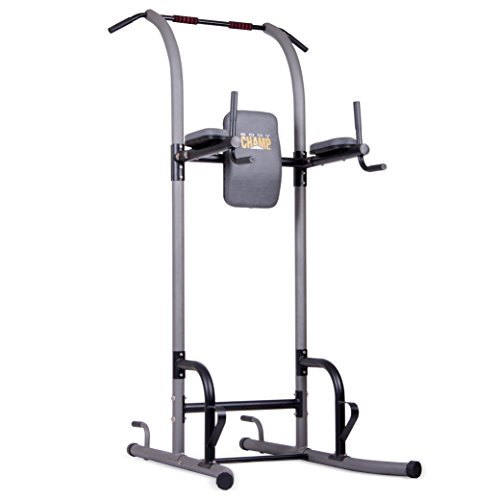
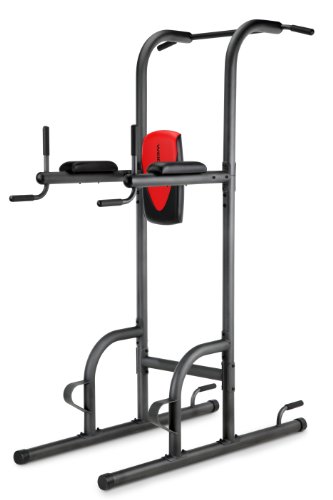
The Body Champ VKR1010 is one of the longest-running power tower designs on Amazon, and it keeps the formula simple: four stations, a wide H-frame base, and no folding parts. The pull-up bar, vertical knee raise station with padded back and arm supports, dip station, and lower push-up bars are all fixed in place, so the setup is the same every session. Its assembled footprint is 55 by 41 inches, wider than the RELIFE, which is floor space spent on stability rather than features.
Specs
- Brand: Body Champ
- Model: VKR1010
- Assembled dimensions: 55 x 41 x 83 in
- Gross weight: 64 lb
- Color: grey
- Stations: pull-up, vertical knee raise, dip, lower push-up bars
- User weight capacity: confirm on the listing
Pick the VKR1010 if you prefer a proven, no-frills station and have the floor width for its base. The listing material reviewed for this guide did not state a user weight limit in the specifications shown, so check that figure on the live listing and stay within the maker’s stated limit.
5. Stamina Power Tower 1690
The Stamina 1690 is the compact option in this group. Its footprint is about 49 by 42.5 inches and it stands 81 inches tall, the shortest here, which makes it easier to fit under lower ceilings and in apartment corners. It still covers pull-ups, dips, a vertical knee raise station, and push-up bars, and adds anchor points used for sit-ups. The listing also includes access to the müüv smart workout app. The compromise is capacity: the maximum weight recommendation is 250 lb, the lowest in this guide.
Specs
- Brand: Stamina
- Model: 50-1690
- Maximum weight recommendation: 250 lb, per the listing
- Assembled dimensions: 49 x 42.5 x 81 in
- Item weight: 54 lb
- Stations: pull-up, dip, vertical knee raise, push-up, sit-up anchor
- App: müüv smart workout app access, per the listing
This is the right tower for a lighter user training with bodyweight only in a small space. If you plan to add load with a dip belt or weighted vest later, or you are close to the limit already, choose a higher-capacity model above instead.
How to Choose a Power Tower
Start with the user weight limit. Add your body weight to anything you plan to wear or hold during training, compare that total against the maker’s maximum weight recommendation, and leave a sensible margin. The limits in this guide range from 250 lb to 440 lb, so this single check removes several models for many buyers.
Next, measure the room. Check the footprint against your floor space, then check the tower height against your ceiling, remembering that your head rises above the bar at the top of a pull-up. Adjustable models such as the Sportsroyals and RELIFE let you lower the bar for low ceilings, while fixed towers such as the Weider and Body Champ need the full clearance from day one.
Then look at the base. Longer and wider bases with more floor contact points generally feel steadier during dips, while suction cup feet and locknuts, as on the RELIFE, help on smooth floors. Place the tower on a level surface, tighten every bolt fully during assembly, and re-check the fasteners after the first few sessions, because small amounts of play are the usual source of wobble.
Finally, match the stations to your program. If knee raises are central to your training, an adjustable backrest is worth having; if you only need pull-ups and dips, a simpler frame is enough. Follow the maker’s instructions and stated limits, and stop using the tower if the frame is damaged or a fitting works loose.
Who Should Skip a Power Tower
Skip a power tower if your door frame already fits a doorway pull-up bar and you only train pull-ups, because the bar stores in a closet and leaves your floor clear. Skip it if your ceiling is too low for the tower height plus head clearance. Skip it if your body weight plus added load exceeds the listed limit of the model you can afford, and skip freestanding towers if you train explosive, swinging movements, since these frames are designed for strict, controlled reps. Anyone with a joint condition or recent injury should get guidance from a qualified professional before starting a bodyweight program.
FAQ
How much ceiling height do I need for a power tower?
The towers here stand between 81 and about 87 inches tall. Beyond the frame height, you need room for your head and hands above the bar at the top of a pull-up, so compare the assembled height on the listing with your ceiling before ordering.
Can a power tower replace a doorway pull-up bar?
Yes, when the door frame is the problem. A tower stands on the floor, so frame width, trim strength, and wall condition do not matter. The trade-offs are floor space, assembly time, and the need for controlled movements, since a freestanding frame is not fixed to the building.
What is the difference between a power tower and a dip station?
A dip station only provides dip handles. A power tower combines those handles with a pull-up bar, a vertical knee raise station with a backrest, and push-up bars in one frame, covering pulling, pushing, and core work without extra equipment.
How do I keep a power tower from wobbling?
Assemble it on a flat, level floor, tighten all bolts in the order the manual specifies, and re-tighten them after the first week of use. Keep movements strict rather than swinging, stay within the listed weight limit, and check that the feet are seated evenly before each session.
Final Verdict
For most buyers, the Sportsroyals Power Tower is the best starting point: the highest listed capacity here, an adjustable bar, and an assisted pad that doubles as the knee raise backrest. The RELIFE is the better pick for shared use across different heights, the Weider suits buyers who want a multi-grip bar from an established brand, the Body Champ VKR1010 is the simple, wide-based classic, and the Stamina 1690 is the pick when space is tight. Confirm the current capacity, dimensions, and included parts on the listing before ordering, because versions and specifications change.